Physical Address
304 North Cardinal St.
Dorchester Center, MA 02124
Physical Address
304 North Cardinal St.
Dorchester Center, MA 02124

Bollywood news, reviews, interviews & fashion
Bollywood news, reviews, interviews & fashion
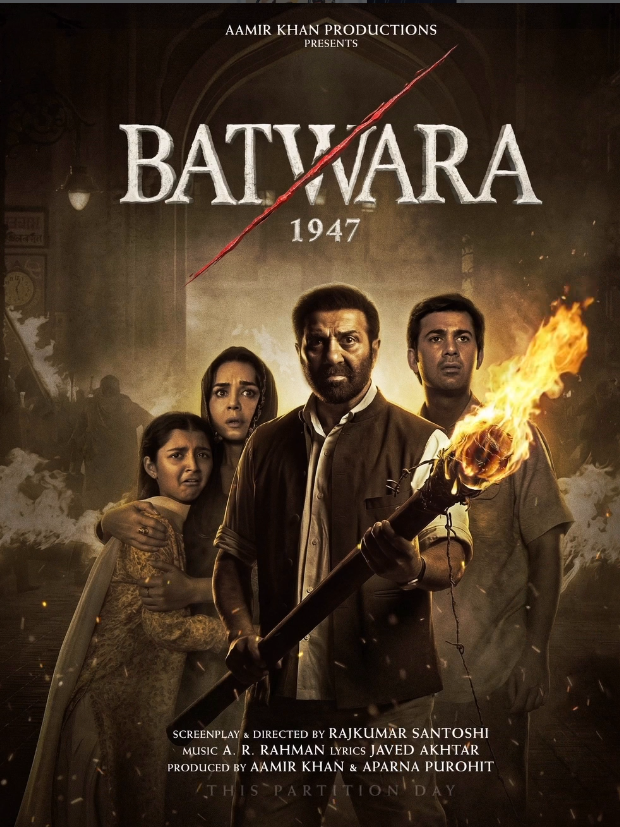
The motion poster of Batwara 1947 generates curiosity with Sunny Deol's intense screen presence, A.R. Rahman's impressive background score, and an intriguing tagline about courage. The title change from Lahore 1947 to Batwara 1947 also appears to be a smart and effective decision.
The motion poster of Batwara 1947 has finally arrived, and it succeeds in doing what a good motion poster should—it generates curiosity without revealing too much. Starring Sunny Deol and Preity Zinta, and directed by Rajkumar Santoshi, the film appears to be aiming for an emotional and powerful take on one of the most turbulent chapters in Indian history.
The biggest highlight of the motion poster is undoubtedly Sunny Deol. Looking intense, determined, and battle-ready, Sunny immediately grabs attention. His piercing gaze and commanding screen presence remind viewers why he remains one of Bollywood’s most powerful performers when it comes to portraying larger-than-life characters. Even without any dialogue, Sunny manages to create intrigue about the character he is playing. Watch our video review
One welcome surprise is the music. A.R. Rahman’s background score in the motion poster sounds impressive and evocative. It has been a while since Rahman’s music has generated this kind of immediate impact in a promotional asset, and the haunting yet stirring composition adds considerable weight to the visuals. The music successfully creates an atmosphere of uncertainty, pain, and hope.
Interestingly, the film was earlier known as Lahore 1947, but the title has now been changed to Batwara 1947. On paper, this feels like a smart move. While Lahore 1947 was specific to a location, Batwara 1947 instantly conveys the larger theme of Partition and its far-reaching consequences. It is a more direct, emotionally resonant, and commercially effective title that immediately communicates the film’s subject matter.
The motion poster also presents the intriguing tagline: “In times of hatred and fear, he chose courage.” This raises an interesting question. What kind of courage are we talking about here? Is it physical courage—the kind of fearless heroism that Sunny Deol is famous for? Or is it emotional courage—the strength to stand for humanity, compassion, and unity in a time of unprecedented violence and division? The answer could define the emotional core of the film.
Another exciting aspect of the project is the reunion of Sunny Deol and Preity Zinta. They have always shared a warm and appealing on-screen chemistry, and they make for a good pair. It will be interesting to see how Rajkumar Santoshi utilizes their dynamic in a story set against the backdrop of Partition.
Speaking of Santoshi, one major question remains unanswered. Will the director present Sunny Deol in a full-fledged action avatar, or will he focus more on the emotional and dramatic aspects of the character? Given Sunny’s immense popularity as an action hero, fans will certainly be hoping for at least a few powerful, whistle-worthy moments. At the same time, the tone of the motion poster suggests that the film may be aiming for something deeper and more emotionally layered.
Overall, Batwara 1947 begins its promotional campaign on a promising note. The intense presence of Sunny Deol, the effective use of A.R. Rahman’s music, the intriguing tagline, and the emotional backdrop of Partition combine to create genuine curiosity about the film. The motion poster may not reveal much, but it leaves viewers wanting to know more—and that is a victory in itself.
Rating: 3.5/5 Stars