Physical Address
304 North Cardinal St.
Dorchester Center, MA 02124
Physical Address
304 North Cardinal St.
Dorchester Center, MA 02124

Bollywood news, reviews, interviews & fashion
Bollywood news, reviews, interviews & fashion
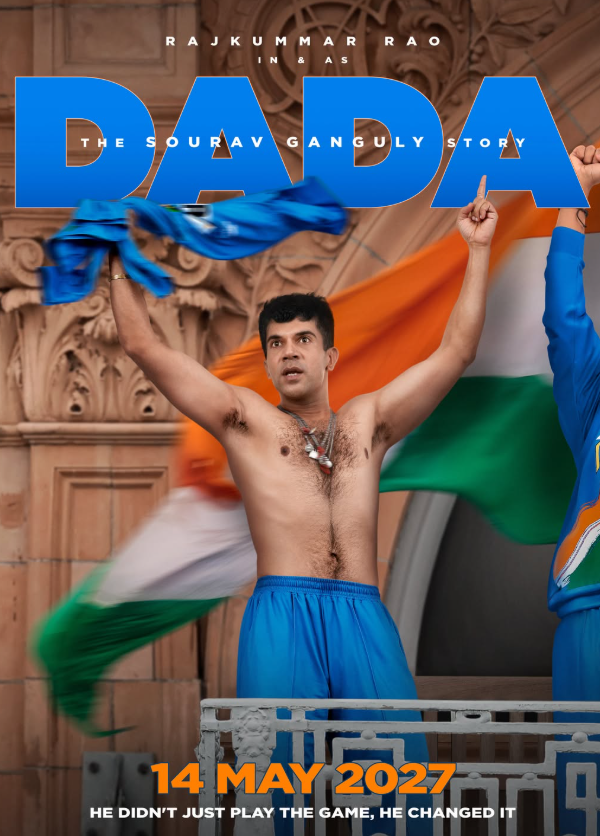
The first-look poster of Dada – The Sourav Ganguly Story, starring Rajkummar Rao, recreates the iconic 2002 NatWest Lord's balcony moment but draws flak for its fan-made, AI-like look and weak resemblance to Ganguly. Can Rao's performance and box office pull rescue the biopic?
On Sourav Ganguly’s 54th birthday, the makers of Dada – The Sourav Ganguly Story unveiled what should have been a goosebump moment: Rajkummar Rao, shirtless, jersey aloft, recreating the single most iconic image in modern Indian cricket — the Lord’s balcony celebration of the 2002 NatWest final. Instead, the internet’s first reaction was a collective squint. Is this… official? Because at first glance, the poster looks less like a Vikramaditya Motwane film backed by Luv Films and T-Series, and more like something a devoted fan cooked up on an image-generation app over a weekend.
Let’s start with the elephant in the frame: this does not look like Sourav Ganguly. It looks like Rajkummar Rao with a haircut. Ganguly on that balcony was wiry, coiled fury — a man who had spent years being told Indian captains don’t do this, doing exactly this. The figure on the poster has none of that edge. The face is oddly smooth and waxy, the expression reads more startled than defiant, and the body language feels posed rather than possessed. The original moment was chaos and catharsis; the poster is a mannequin mid-gesture.
Then there’s the texture of the image itself, which invites the most damaging accusation a first look can attract in 2026: that it resembles a bad AI-generated composite. The over-polished skin, the strangely plasticky lighting on the torso, the flags that swirl with a motion blur that obeys no consistent physics, the second cropped figure on the right whose arm seems to belong to nobody in particular — all of it has that telltale synthetic sheen. Whether or not any generative tools were actually used, the fact that the question even arises is a design failure. A first look exists to sell authenticity, especially for a biopic. This one sells doubt.
The graphic design doesn’t help. The gigantic blue “DADA” slapped across the top swallows the entire upper third of the frame, decapitating the composition and burying the very balcony architecture that gives the moment its meaning. The strip reading “The Sourav Ganguly Story” cuts through the title like an afterthought. The saffron release date at the bottom, paired with the tagline “He didn’t just play the game, he changed it,” is boilerplate sports-movie copy that could sit under any cricket film made in the last fifteen years. For a film directed by Motwane — a filmmaker whose visual instincts gave us the grit of Trapped and the texture of Jubilee — this poster is shockingly generic. It has the fingerprints of a marketing deck, not a director.
Compare this with how the 83 first look handled Kapil Dev’s Natraj shot, or how M.S. Dhoni: The Untold Story leaned on silhouette and restraint. Those posters understood that an iconic sporting image needs reverence, not decoration. This one buries the icon under fonts.
Here is the necessary caveat, and it’s a big one: a bad poster has never sunk a good performance, and Rajkummar Rao has spent a decade making sceptics eat their words. This is the actor who disappeared into Newton, into Subhash Kapoor’s Shahid, into the physical extremity of Trapped under this very director. If anyone in this generation of actors can find Ganguly — not the face, but the man — it is arguably Rao.
Because Ganguly was never about looks anyway. He was about mannerisms: the leisurely walk to the crease, the off-side flourish that made Rahul Dravid crown him God of the off side, the deliberately delayed toss walk-outs that infuriated Steve Waugh, the collar-popped arrogance that masked a Kolkata boy’s sentimentality. That is the real audition. A still image cannot capture the cover drive or the swagger; a trailer can, and a film must. Ganguly himself has endorsed the casting publicly, saying he can’t wait to see Rao play his cover drive — and Dada was never one to hand out compliments to mediocrity. The jury should stay out until we see Rao move, bat and captain on screen.
The harder question is commercial. Rajkummar Rao is a critics’ darling and a streaming-era favourite, but his theatrical track record as a solo draw is patchy — for every Stree franchise success, there are films that struggled to open. Sports biopics, meanwhile, are no longer the guaranteed gold they were in the Dangal and M.S. Dhoni era; 83, with Ranveer Singh and a World Cup win as its subject, underperformed badly.
Dada has two things going for it: Ganguly’s near-religious following in Bengal, which alone can power a strong regional opening, and the emotional pull of the NatWest generation, now in their 30s and 40s with buying power. But converting nostalgia into pan-India footfalls will need a campaign far sharper than this opening salvo. If the first look is anything to go by, the marketing team has work to do before May 14, 2027.
The moment on that Lord’s balcony changed Indian cricket forever. This poster, unfortunately, changes nothing — except perhaps the burden of proof, which now sits squarely on the film itself.