Physical Address
304 North Cardinal St.
Dorchester Center, MA 02124
Physical Address
304 North Cardinal St.
Dorchester Center, MA 02124

Bollywood news, reviews, interviews & fashion
Bollywood news, reviews, interviews & fashion
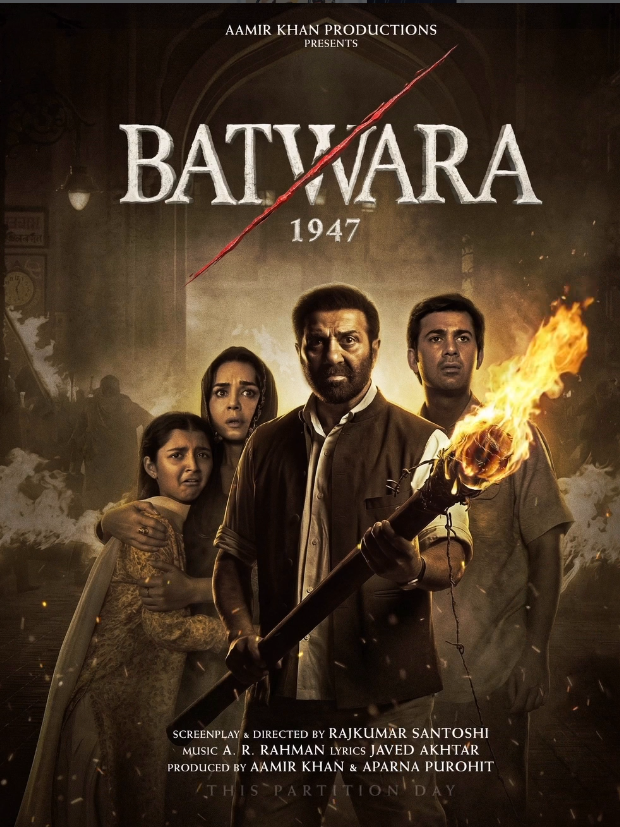
From written-off to unstoppable — Gadar 2, Jaat and Border 2 have made Sunny Deol Bollywood's most improbable box office phenomenon. Now, as Rajkumar Santoshi's Batwara 1947 hits screens this Independence Day weekend against Awarapan 2, we analyse whether the Deol juggernaut can convert with a sombre Partition epic. Full deep-dive inside.
By Bollywoodwallah
In an industry obsessed with youth, six-pack abs and algorithm-friendly stardom, the most fascinating box-office story of the decade belongs to a 68-year-old man with a hand pump. Sunny Deol’s late-career resurgence is not merely a comeback; it is a full-blown commercial phenomenon that has rewritten every assumption the trade held about ageing stars, mass-circuit loyalty and the shelf life of nostalgia. And this Independence Day weekend, as Rajkumar Santoshi’s long-awaited Partition drama Batwara 1947 arrives in cinemas, the question hanging over the industry is a compelling one: can the Deol juggernaut convert yet again — this time with a sombre period epic rather than a chest-thumping actioner?
To appreciate the scale of this resurgence, one must remember where Sunny Deol stood before August 2023. For nearly two decades, the man who once owned the single-screen heartland with Ghayal, Damini, Ghatak, Border and Gadar had been written off as a relic — a star whose brand of dhai-kilo-ka-haath heroism belonged to a bygone era. His theatrical outings through the 2010s barely registered; the trade had, for all practical purposes, phased him out as a box-office entity.
Then came Gadar 2. Released on August 11, 2023 — three years ago almost to the day — Anil Sharma’s sequel detonated at the box office with a force nobody, including Deol himself, saw coming. The film stormed past ₹515 crore net in India within a month, ultimately finishing as one of the highest-grossing Hindi films in history. Tara Singh’s return did not just revive a franchise; it revived an entire ecosystem — the mass single-screen audience that the multiplex era had presumed dead came roaring back, whistling, dancing and tearing tickets in numbers the industry hadn’t witnessed since the pre-pandemic peak.
Overnight, Sunny Deol went from forgotten legend to the hottest signing in Bollywood.
The first true test of whether Gadar 2 was lightning in a bottle or the start of a genuine second innings arrived on April 10, 2025, with Jaat — Gopichand Malineni’s Hindi directorial debut, backed by the Pushpa producers Mythri Movie Makers, and pitting Deol against a deliciously menacing Randeep Hooda.
The verdict was instructive. Jaat opened at ₹9.62 crore — the fourth-biggest Bollywood opening of 2025 at that point — and closed its India run at roughly ₹85 crore net, with a worldwide gross in the region of ₹112 crore. By the stratospheric standards Gadar 2 had set, these were modest numbers. But context is everything: this was a non-franchise, southern-styled massy actioner with mixed-to-positive reviews, and it still comfortably out-opened most of Bollywood’s younger A-listers that year. Crucially, it proved that Deol’s opening-day pull — the hardest currency in the theatrical business — had survived independent of the Gadar brand. The heartland was showing up for Sunny Deol, not just for Tara Singh.
If Jaat was the stress test, Border 2 was the confirmation. Released on January 23, 2026, Anurag Singh’s war epic — with Deol leading an ensemble of Varun Dhawan, Diljit Dosanjh and Ahan Shetty — opened to a thunderous ₹32 crore-plus day one, crossed ₹100 crore in India within three days, and outgunned Ranveer Singh’s Dhurandhar through its opening frame, with the Republic Day holiday supercharging its first Monday.
The film ultimately closed with approximately ₹362 crore net in India and a worldwide gross reported between ₹420 and ₹485 crore, recovering its mammoth ₹275 crore budget within three weeks and posting a healthy profit. It now stands as the second-highest-grossing film of Sunny Deol’s career, behind only Gadar 2.
Yes, a section of the trade grumbled that Border 2 “underperformed” against ₹500-crore expectations — but that grumble is itself the greatest testament to the resurgence. Only three years ago, nobody expected a Sunny Deol film to open at all. Today, a ₹400-crore-plus worldwide blockbuster is judged against the man’s own impossible benchmark. Three consecutive theatrical successes — Gadar 2, Jaat, Border 2 — across three different genres and banners is a streak no other Hindi film star of any generation can currently claim.
Which brings us to Batwara 1947 — arguably the riskiest and most artistically ambitious film of this entire second innings.
Consider the pedigree. This is Aamir Khan Productions’ most prestigious offering in years, directed by National Award winner Rajkumar Santoshi — the filmmaker who sculpted the very foundation of Sunny Deol’s legend with Ghayal, Damini and Ghatak, reuniting with his muse after nearly three decades. The film is adapted from Asghar Wajahat’s acclaimed play Jis Lahore Nai Vekhya, O Jamya E Nai, shot by the legendary Santosh Sivan, scored by A.R. Rahman with lyrics by Javed Akhtar, and boasts a formidable ensemble: Preity Zinta returning to the big screen opposite Deol, Shabana Azmi, Ali Fazal, Abhimanyu Singh, and Karan Deol sharing the frame with his father. Originally titled Lahore 1947, the film was reportedly rechristened Batwara 1947 to sidestep political controversy — a small but telling indicator of how delicately the makers are treading with this material.
On paper, the Partition setting slots perfectly into the Deol resurgence playbook — after all, Gadar itself was a Partition saga, and the sight of Sunny Deol raging against the tragedy of 1947 is practically embedded in the national consciousness. The Independence Day release corridor, which delivered Gadar 2’s historic haul on this very weekend three years ago, only deepens the sense of destiny.
And yet, an honest assessment demands acknowledging the challenges — and they are considerable.
First, this is not a Gadar. Batwara 1947 is, by all indications, a sombre, humanist period drama about families torn apart by the Partition — closer in spirit to Santoshi’s dramatic sensibilities than to hand-pump heroics. The A certificate and 2-hour-25-minute runtime position it as serious adult cinema, not a family holiday entertainer. Deol’s resurgence has thus far been powered by mass action; this film asks his audience to follow him into far more contemplative territory.
Second, the clash. The film opens against Emraan Hashmi’s Awarapan 2 — a sequel to a bona fide cult favourite — and early advance booking trends tell a sobering story. In the opening hours of pre-sales at the national chains, Awarapan 2 raced ahead by a wide margin, with Batwara 1947 selling a fraction of its rival’s tickets, and the gap on BookMyShow interest metrics equally one-sided. Awarapan 2’s U/A certificate and tighter runtime give it a broader accessibility advantage on a holiday weekend.
Third, the long gestation. Originally slated for January 2025, the film sat through extended post-production and a title change — delays that can dull pre-release momentum even for the most anticipated projects.
So, can Batwara 1947 carry the winning trend forward? The trade math says it faces an uphill opening. But the trade math also said Gadar 2 would do ₹250 crore, and it did more than double that. If there is one lesson of the past three years, it is that Sunny Deol’s equity with the Hindi heartland operates outside conventional tracking — his audience doesn’t pre-book; it walks in.
Moreover, this film doesn’t need Gadar 2 numbers to succeed. If word-of-mouth crowns it as the emotionally powerful, awards-calibre epic its pedigree promises — Santoshi’s redemption, Rahman’s score, Azmi and Zinta in career-highlight roles — it can build the kind of slow-burning, long-legged run that prestige dramas thrive on, and add an entirely new dimension to Deol’s resurgence: critical vindication to go with commercial conquest.
Whether Batwara 1947 opens with a bang or builds with a whisper, one truth is already beyond dispute: at 68, Sunny Deol is enjoying the most remarkable third act in the history of Hindi film stardom. The hand pump, it turns out, was never just a prop. It was a prophecy.