Physical Address
304 North Cardinal St.
Dorchester Center, MA 02124
Physical Address
304 North Cardinal St.
Dorchester Center, MA 02124

Bollywood news, reviews, interviews & fashion
Bollywood news, reviews, interviews & fashion
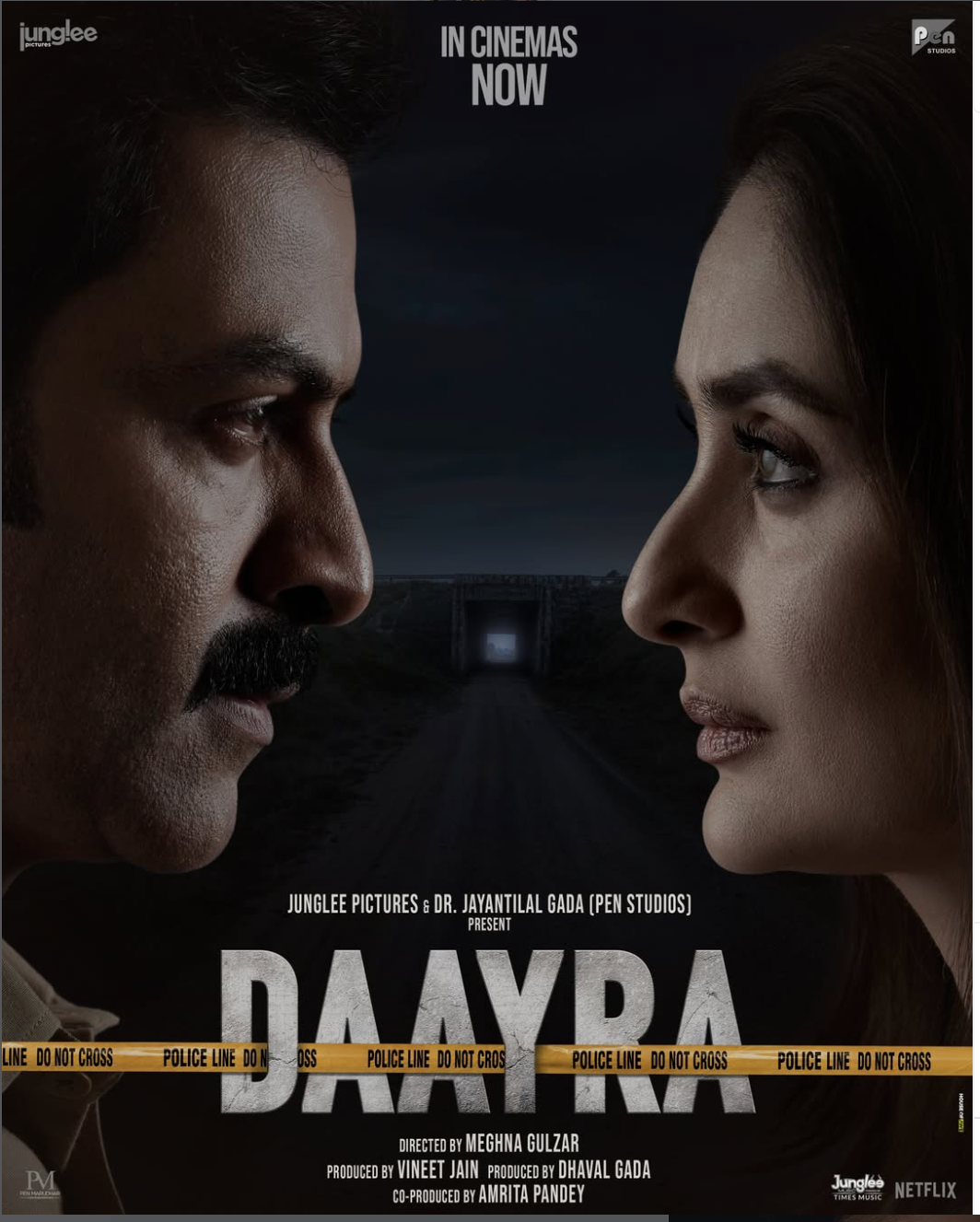
Meghna Gulzar’s *Daayra* tackles a disturbing real-life-inspired case but struggles to turn its weighty subject into compelling cinema. Despite strong performances from Pragati Mishra and others, the film is held back by sluggish pacing, static storytelling, underutilised actors and a disappointing climax.
Meghna Gulzar’s Daayra arrives carrying the weight of an inherently powerful subject. Inspired by the tragic 2019 Hyderabad veterinary doctor case, the film ventures into difficult territory: institutional failure, police accountability, systemic injustice and the uneasy moral questions surrounding the infamous encounter that followed. In the hands of a filmmaker known for bringing gravitas and dramatic precision to real-life stories, the material promises a tense, morally complex procedural. Instead, Daayra becomes a curiously inert film—one that mistakes seriousness for substance and restraint for dramatic depth.
The film’s biggest problem is its fundamental understanding of cinematic tension. A story built around a missing woman, a police investigation and the fallout of a controversial encounter should inherently possess a ticking-clock quality. Yet Daayra repeatedly allows that urgency to evaporate. The screenplay is weighed down by long, static exchanges and stretches of exposition that feel more suited to a briefing room than a feature film. The opening half-hour, in particular, takes an interminable amount of time establishing circumstances that could have been conveyed with considerably greater economy.
There are flashes of the film it might have been. The flashbacks inject some life into the narrative, while a brief police chase finally provides the propulsion one expects from a crime thriller. But these moments are frustratingly isolated. Once the second half begins, Daayra retreats into prolonged scenes of officials sitting, eating, discussing and dissecting the case. Information is repeatedly verbalised rather than dramatically experienced. The result is a film that is constantly talking about its stakes without making the audience feel them.
More baffling is the film’s handling of its considerable acting talent. Kareena Kapoor Khan, positioned prominently in the film’s publicity, is given remarkably little to work with. As a member of the inquiry commission, her character should theoretically provide an important emotional and investigative counterpoint to the proceedings. Instead, she remains largely peripheral, rarely afforded a scene that genuinely tests her dramatic range or gives the character any meaningful emotional trajectory. It is an extraordinary underutilisation of a major star.
The film instead places much of its narrative weight on Prithviraj Sukumaran, who receives the kind of commanding introduction one expects from a central protagonist. But the performance is undermined by the film’s excessively muted direction. The deliberate restraint never quite develops into complexity, and the accent occasionally becomes distracting rather than invisible. The problem isn’t the actor’s lack of ability; it is that the filmmaking around him never gives the performance enough dramatic architecture to flourish.
Jitendra Joshi suffers an even more perplexing fate. An actor of considerable range, he is reduced to little more than a presence in the background, often sitting and taking notes while more consequential characters conduct the conversation. When a film assembles this much talent and then struggles to give its performers meaningful dramatic functions, the problem clearly lies higher up the filmmaking chain.
The most serious failure, however, arrives in the climax. This is where Daayra should finally unleash the emotional and moral force that its subject demands. The victim, played with extraordinary vulnerability by Pragati Mishra, provides the film with its most affecting performance. Her scenes carry the possibility of transforming the story from a procedural exercise into something genuinely devastating.
Instead, the editing repeatedly fractures that emotional momentum. At precisely the moments when the audience needs to remain with the victim and absorb the horror of what is unfolding, the film cuts away to Prithviraj’s perspective. The cross-cutting may be intended to create parallel tension, but it has the opposite effect. It distances us from the emotional centre of the sequence and dissipates the outrage that the scene should naturally generate. What ought to be a shattering climax consequently feels strangely muted.
There are glimpses of a stronger film scattered throughout Daayra. Pragati Mishra brings remarkable intensity to her role, while Kshitee Jog makes an impression in her limited space. These performances hint at the emotional complexity the film could have achieved had the screenplay been less burdened by exposition and the direction more attuned to dramatic rhythm.
Ultimately, Daayra is not undone by the weakness of its subject but by the failure to translate that subject into compelling cinema. Meghna Gulzar has chosen material loaded with institutional, political and emotional possibilities, yet the film rarely converts those possibilities into tension. Its seriousness becomes ponderous, its restraint becomes inertia, and its ambition is repeatedly undermined by structural and editorial choices.
For a story that should leave the audience disturbed, angry and emotionally shaken, Daayra instead leaves behind a far more frustrating feeling: the sense of a potentially powerful film that never quite found its pulse.