Physical Address
304 North Cardinal St.
Dorchester Center, MA 02124
Physical Address
304 North Cardinal St.
Dorchester Center, MA 02124

Bollywood news, reviews, interviews & fashion
Bollywood news, reviews, interviews & fashion
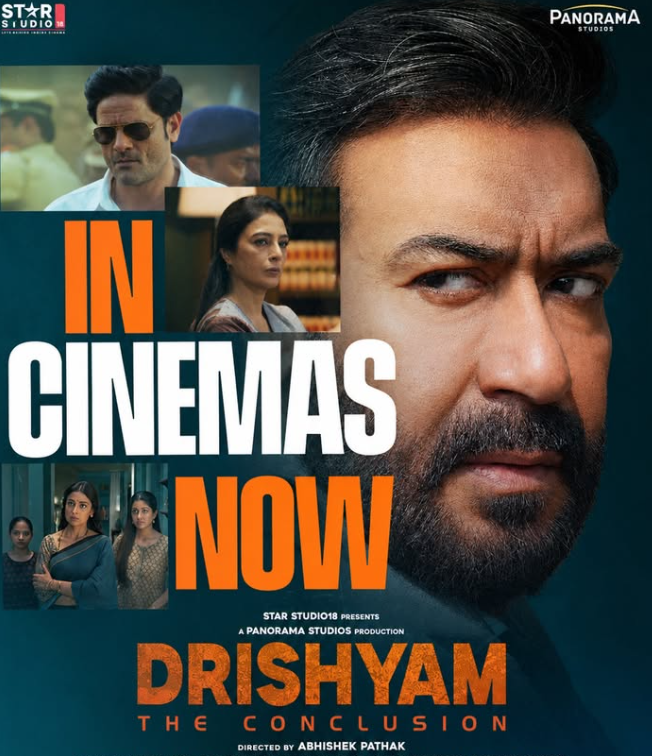
Drishyam 3: The Conclusion is a superbly written and directed finale packed with twists. Ajay Devgn, Jaideep Ahlawat and Kamlesh Sawant shine, though one question about the skeletal remains is never asked.
Great franchises are hard to end well. Audiences arrive with the weight of memory and expectation, and a closing chapter must satisfy both without repeating itself. Drishyam 3: The Conclusion does this and more. It is an outstanding film, superbly written and directed, and it closes the saga of Vijay Salgaonkar with a confidence that few Hindi thrillers can match.
When a franchise sets the benchmark as high as Drishyam (2015) and Drishyam 2 (2022, a ₹345 crore hit) did, a third chapter is like walking over a canyon. Writer-director Abhishek Pathak, working with co-writers Aamil Keyan Khan and Parveez Shaikh, wisely refuses to recycle the old formula. The film brings a fresh, emotionally driven narrative that explores the nuances of truth, deception and the stories we tell ourselves. Several Mahabharata references are scattered through the script, and given how everything plays out, they are entirely fitting. It is a chess match dressed up as a family drama, and the writing is the film’s greatest asset.
What strikes you most is how relentlessly the film keeps you guessing. There are twists and turns from the very start to the very end, each one earned and none feeling like a cheat. The screenplay layers its revelations so carefully that you dare not look away, and a missed two minutes might cost you the thread of the puzzle. Pathak builds this world with patience and intricacy, trusting the audience’s intelligence rather than spoon-feeding it.
Three sequences in particular deserve celebration. The marriage meet scene in the first half is a marvel of tension disguised as social comedy. Everyone is smiling, everyone is polite, and yet the air is thick with menace, and the scene plants seeds that pay off handsomely later. In the second half, the courtroom and graveyard sequences are the film’s twin peaks. The courtroom is a masterclass in dramatic staging, where every question and silence carries weight. The graveyard sequence, atmospheric and unsettling, raises the stakes to their highest pitch. Both rocked the house, and I suspect they will be discussed for years.
Ajay Devgn is superb as Vijay Salgaonkar. This is the sort of performance that lives in stillness, and he allows his silence to shine. Devgn understands that Vijay’s power lies in what he withholds. A flicker of the eyes or a half-smile says more than a page of dialogue, and his restraint makes the quiet moments crackle. One critic described his performance as reaction-based, and that is exactly right: he lets the storm rage around him while his calm does the talking. It is secure, generous acting, and Devgn also lets his co-stars shine.
Jaideep Ahlawat is outstanding as Crime Branch SP Rajveer Singh Tomar, the franchise’s newest antagonist. He gets an entrance worthy of a mass hero, and when he appears before Vijay, you can see the man visibly rattled. Ahlawat plays Tomar with controlled fury and a predator’s patience, and his exchanges with Devgn, smirk against fire, are the film’s beating heart. They are written to build genuine tension, and the background score amplifies that tension beautifully. Tabu, Shriya Saran, Rajat Kapoor and Prakash Raj lend solid support, with Raj especially effective.
And then there is Kamlesh Sawant, returning as Laxmikant Gaitonde, the film’s standout. Gaitonde was always a character audiences loved to hate, but here Sawant also makes him funny, and the comic timing adds welcome levity without ever deflating the tension. It is a performance that proves how much a well-drawn supporting role can elevate a thriller.
If I must find fault, there is one loophole, and it is a conspicuous one. The main question the judge never asks concerns the skeletal remains. In a film so meticulously constructed, the omission of this obvious question stands out, and a sharp viewer will notice it. It does not break the film, and the sheer momentum and craft carry us past it, but it is a flaw in an otherwise near-flawless screenplay.
On the whole, Drishyam 3: The Conclusion is a gripping, intelligent and deeply satisfying finale. It honours the franchise’s spirit of an ordinary man with an extraordinary mind and a story told so well that everyone believes it. With superb writing, assured direction and a cast at the top of their game, it is a must-watch. Book your tickets, and don’t be late.