Physical Address
304 North Cardinal St.
Dorchester Center, MA 02124
Physical Address
304 North Cardinal St.
Dorchester Center, MA 02124

Bollywood news, reviews, interviews & fashion
Bollywood news, reviews, interviews & fashion
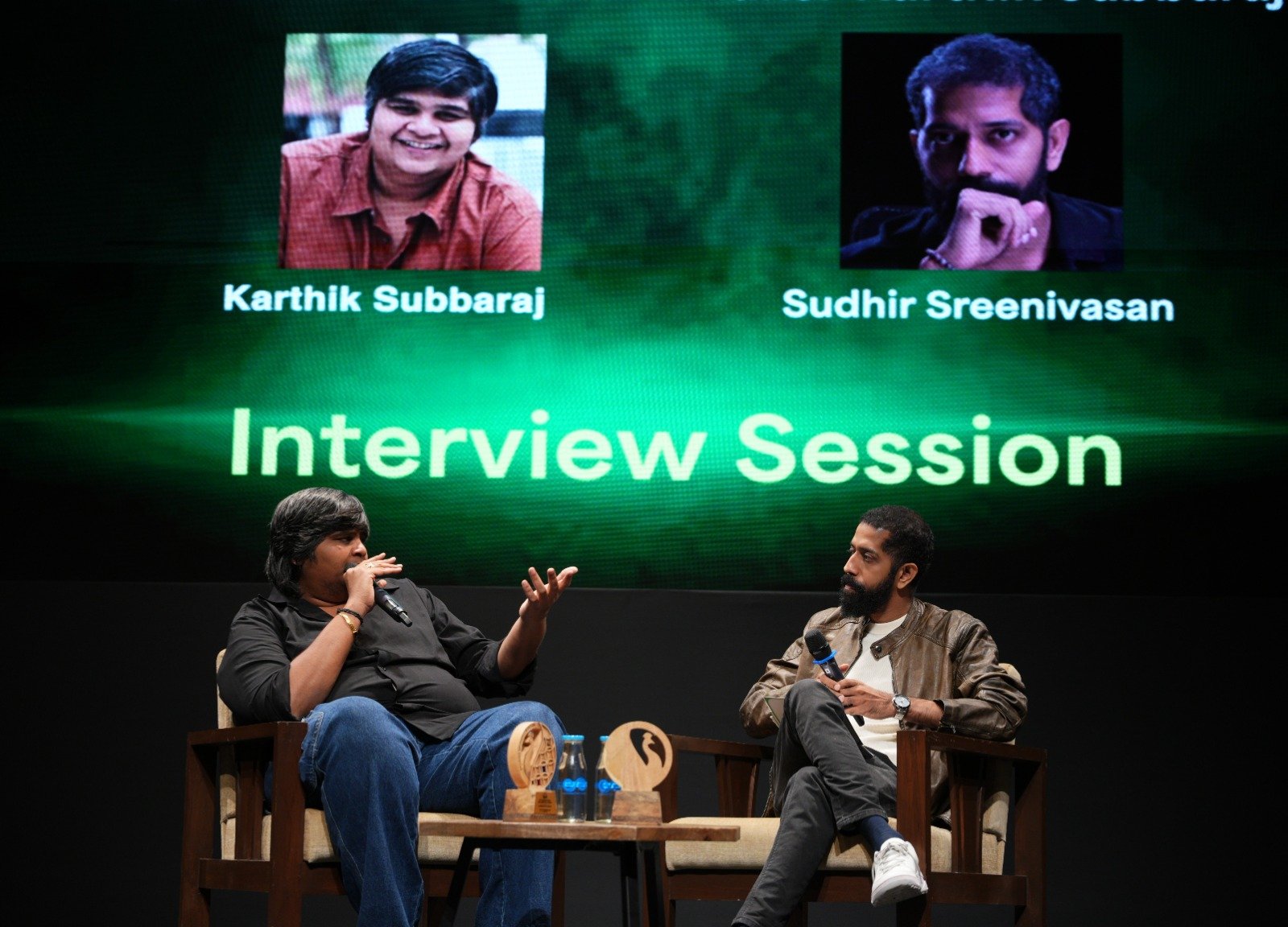
At IFFI 2026, filmmaker Karthik Subbaraj discusses how villains are often shaped by society, patriarchy and social conditioning, rather than individual evil alone.
At the 57th International Film Festival of India in Goa, the filmmaker discusses patriarchy, morality, social prejudices and how cinema can become an instrument of change.
What makes someone a villain? Is it simply their actions, or are they also products of the society and circumstances they grow up in? Filmmaker Karthik Subbaraj explored these questions during an engaging conversation at the 57th International Film Festival of India (IFFI) in Goa.
During an interview session titled What If the Villain Is Right?, moderated by film critic Sudhir Srinivasan, the filmmaker shared his thoughts on morality, human behaviour and the blurred boundaries between good and evil.
Subbaraj emphasised that villainy cannot always be attributed to one individual. Sometimes, it is a reflection of deep-rooted social attitudes, prejudices and conditioning.
“The base is grey for everyone,” he observed, explaining how people’s circumstances and social experiences influence their behaviour and how society perceives them.
Discussing his film Dorothy, Subbaraj drew a distinction between characters who consciously engage in evil acts and those whose harmful behaviour is driven by deeply ingrained prejudices.
He cited Whistle Veeraiya as an example of an overtly evil character. However, he suggested that seemingly ordinary characters, such as the parotta shop owner, could be equally dangerous because they may not even recognise their own prejudices or wrongdoing.
The filmmaker further explained that Dorothy explores masculinity and patriarchal attitudes as the forces responsible for the protagonist’s death. Rather than presenting an individual as the sole antagonist, the film examines how oppressive mindsets and social conditioning can become the real villains.
Drawing a parallel with his film Mercury, Subbaraj spoke about how the collective mentality of a village can also be portrayed as an antagonist, highlighting how social attitudes can influence individual behaviour.
The filmmaker also reflected on the emotional consequences of humiliation and the importance of accountability.
According to Subbaraj, ridiculing someone or laughing at their inability can sometimes hurt far more than reprimanding them. He also discussed remorse and guilt as forms of punishment, pointing out that the consequences of one’s actions do not necessarily have to involve physical suffering or death.
One of the interesting aspects of the conversation was Subbaraj’s perspective on cinema as a medium that can influence society.
Recollecting audience reactions to Dorothy, the filmmaker spoke about instances where viewers became more accepting of transgender people, while some male viewers were emotionally moved by the film.
Such responses strengthened his belief that cinema can go beyond entertainment and encourage empathy, understanding and social change.
He also revealed that the idea of using storytelling to influence social attitudes had informed his approach to Jigarthanda.
Throughout the conversation, Subbaraj reiterated that he does not particularly believe in portraying characters as completely virtuous heroes or irredeemably evil villains.
Instead, he prefers leaving moral judgments open to interpretation, allowing audiences to understand characters through their motivations, circumstances and personal perspectives.
The session offered an interesting insight into the filmmaker’s storytelling philosophy, which challenges conventional ideas of good and evil.
Interestingly, his thoughts also resonate with the overarching theme of IFFI 2026, Stories Without Borders. By exploring social realities through culturally rooted narratives, Subbaraj believes cinema can raise universal questions about morality, empathy and human behaviour.
The 57th International Film Festival of India is being held in Goa from November 20 to 28, 2026.