Physical Address
304 North Cardinal St.
Dorchester Center, MA 02124
Physical Address
304 North Cardinal St.
Dorchester Center, MA 02124

Bollywood news, reviews, interviews & fashion
Bollywood news, reviews, interviews & fashion
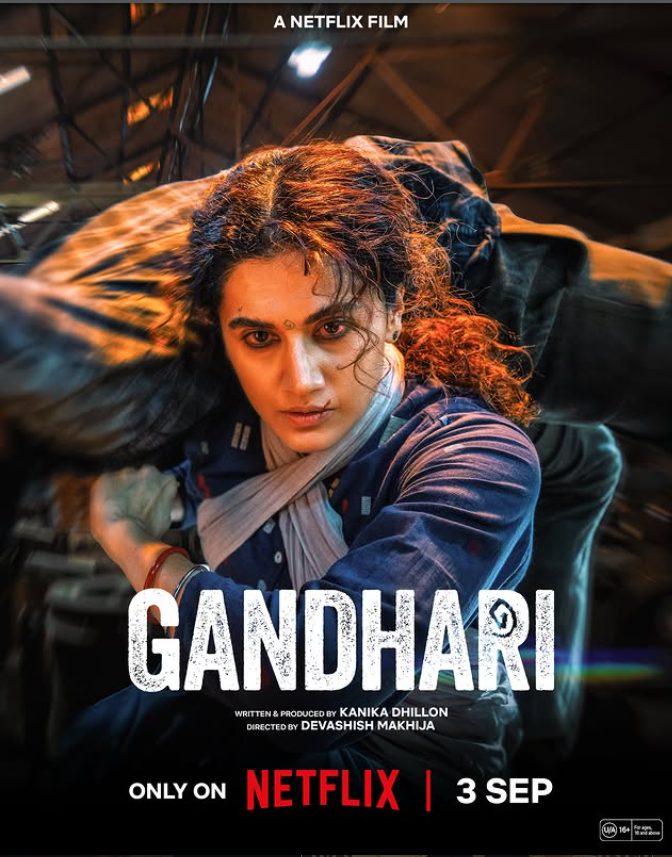
A stinging critique of Netflix’s Gandhari, analyzing its absurd plot, wasted ensemble cast, and Taapsee Pannu’s unconvincing central performance in a derivative action-thriller.
There are cinematic misfires, and then there are catastrophic artistic bankruptcies. Gandhari, the latest straight-to-streaming disaster dropped onto Netflix India, firmly belongs in the latter category. Derivative, entirely devoid of tension, and structurally hollow, the film stands as a glaring testament to a streaming giant that seems content with dumping low-effort content onto a helpless audience. Designed loosely as a revenge thriller following a mother’s relentless pursuit, the picture borrows heavily from far superior action films like Mardaani, yet lacks a single shred of the grit, intelligence, or narrative muscle required to justify its existence.
At the center of this narrative wreckage is the central plot premise, which collapses under the weight of its own staggering absurdities. The story kicks off with the protagonist’s child being abducted from a train, followed immediately by a blow to the mother’s head that induces temporary blindness. Where any sensible story would end, Gandhari leaps off a cliff of logic. The heroine transforms overnight into a pseudo-superhero, complete with a blindfold, handing out pamphlets, and undergoing cartoonish martial arts training under a mentor. The plot meanders through painfully predictable twists and turns, culminating in ludicrous set-pieces—including an unintentionally hilarious moment where a character wields a shield like a bootleg Captain America, and an absurd hand-to-hand fight scene that carries all the gravity of a heated altercation in a ladies’ train compartment.
The film’s most glaring vulnerability, however, lies in its central performance. Taapsee Pannu delivers an excruciatingly unconvincing portrayal that highlights a troubling regression in her craft. Acting requires nuance, conviction, and emotional resonance; here, we are treated to a flat, amateurish execution that feels more like an untrained actor attempting a high-stakes action role than an established lead holding up a feature-length film. In an era where female-led blockbusters require absolute star power and dramatic gravity—qualities demonstrated by true heavyweights of the industry—this performance fails to command the screen, rendering the entire exercise thoroughly unbelievable.
What makes Gandhari even more infuriating is its criminal squandering of genuine talent. Brilliant character actors such as Mita Vashisht, Ishwak Singh, and Jatin Sarna are reduced to mere background props, playing second fiddle in a script that doesn’t know what to do with them. Mita Vashisht’s formidable presence is completely wasted in a empty, throwaway role, while Ishwak Singh’s refined capabilities are entirely muted. To make matters worse, when a formidable villain finally steps into the frame, the narrative dynamic entirely collapses because the protagonist lacks the acting weight to match his screen presence, leaving a glaring void where the central conflict should have burned.
In the end, Gandhari is nothing short of a cinematic travesty—an ill-conceived, tensionless thriller stuffed with ridiculous twists that insult the viewer’s intelligence. Netflix India has once again served up pure creative wreckage, relying on absurd tropes rather than cohesive storytelling or solid acting. It stands as a stark reminder that high-concept action thrillers cannot survive on sheer ambition alone; without craft, logic, and convincing performances, even the most explosive premise falls completely flat.