Physical Address
304 North Cardinal St.
Dorchester Center, MA 02124
Physical Address
304 North Cardinal St.
Dorchester Center, MA 02124

Bollywood news, reviews, interviews & fashion
Bollywood news, reviews, interviews & fashion
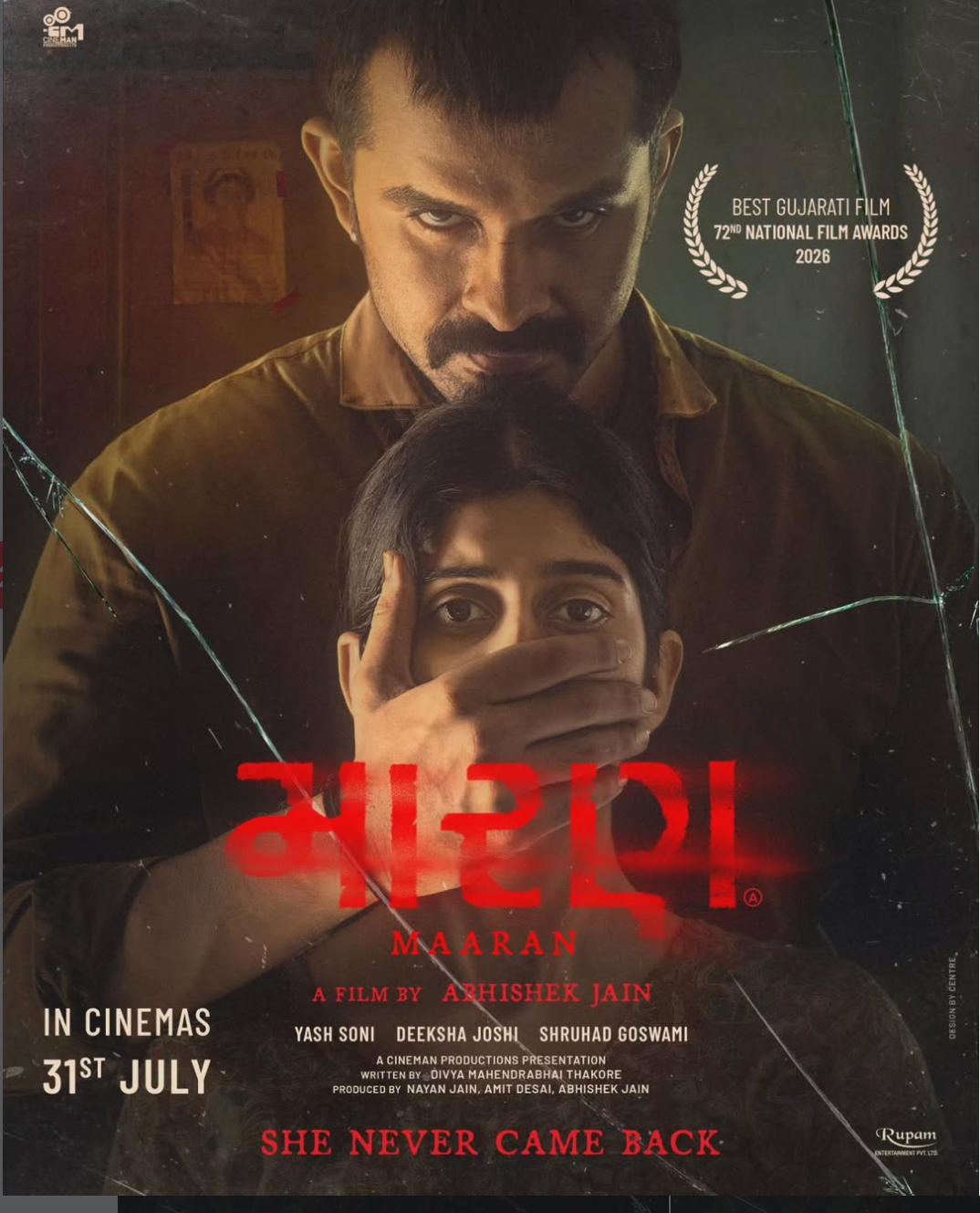
Abhishek Jain's National Award-winning Gujarati film Maaran is a chilling study of Stockholm Syndrome and the social stigma that greets a kidnapping survivor. Anchored by Deeksha Joshi's devastating performance and Yash Soni's quietly menacing villain, it's a psychological drama that lingers long after the final frame. Our full review.
By Sonup Sahadevan
Rating: ★★★★☆ (4/5)
Once in a while, a film arrives from beyond the Hindi heartland and quietly shakes the mainstream. Abhishek Jain’s Maaran, winner of the National Award for Best Gujarati Film, is that film — a chilling, rigorously honest study of captivity, survival, and the crueller prison that awaits a victim once she finds ‘freedom’
Drawn from real-life events, Maaran builds its narrative around Stockholm Syndrome — the disquieting psychological phenomenon in which a captive, isolated and terrified, begins to bond with the very person holding her hostage. Lesser filmmakers have mined this territory for cheap thrills. Jain, writer Divya and producer Amit Desai venture to do something braver: they treat it as what it actually is — a survival mechanism, a mind rewiring itself to stay alive when every exit is sealed.
But the film’s real masterstroke is its second act of cruelty. When the kidnapped woman finally attempts to return home, Maarana asks the question our society dreads: what happens next? The answer is devastating. No sanctuary, no healing — only whispers, suspicion, and the slow ostracisation of a woman whose only crime was surviving. The film argues, persuasively, that this secondary trauma cuts deeper than the captivity itself. It is social commentary delivered not as a lecture, but as a wound.
Jain has no patience for formula. Maaran opens with a disorienting, high-impact sequence that pulls the ground from under the viewer, then withholds its answers with surgical patience. When Yash Soni and Shruhad Goswami enter the frame, the ambiguity thickens — allies? victims? something murkier? The film trusts its audience to sit with that uncertainty, and the payoff, when the pieces finally lock into place, is all the richer for it.
Is it flawless? No. The midsection sags briefly, and Jain’s decision to skip the procedural mechanics of the kidnapping itself trades away some conventional tension. But these are quibbles against the film’s suffocating psychological grip, which never truly loosens.
The washroom confrontation. The film’s emotional core is a conversation between Deeksha Joshi’s protagonist and her mother, staged inside a washroom. It is familial betrayal rendered in close quarters — raw, airless, unbearable.
The half-lit stare. Soni’s villainy introduced with one face split between light and shadow, eyes boring straight through the screen. It’s a simple visual, and a perfect one — duality made flesh.
The bench dialogue. Tarjanee Bhadla’s Purva sits across from Soni and tries to seize control of the conversation. Watch her bravado disintegrate, beat by beat, into tears and terror. It is a masterclass in the choreography of power.
Deeksha Joshi is the film’s beating, bruised heart. She walks the impossible line between terror, attachment, and self-preservation with astonishing control, and her defining line — that her will to survive was so fierce it forced her to form a bond with a worthless man — lands like a body blow.
Yash Soni meanwhile delivers a chilling, commanding turn as the captor, mastering the art of quiet intimidation. He craftily balances charm and menace, giving the audience a villain they genuinely “love to hate.”
Tarjanee Bhadla, Prachi, & Shruhad Goswami: The supporting cast adds vital emotional texture. Bhadla’s portrayal of shifting vulnerability is remarkable, while Prachi and Goswami lend grounded credibility to the surrounding narrative fabric.
Maaran offers no neat resolutions. Its final note is a chill down the spine — the suggestion that trauma is not an event but a cycle, and that this story may not be finished. That refusal to comfort is precisely what makes it essential.
This is Gujarati cinema at its boldest, and a National Award richly earned. Seek it out.
★★★★☆ — A haunting, humane triumph.