Physical Address
304 North Cardinal St.
Dorchester Center, MA 02124
Physical Address
304 North Cardinal St.
Dorchester Center, MA 02124

Bollywood news, reviews, interviews & fashion
Bollywood news, reviews, interviews & fashion
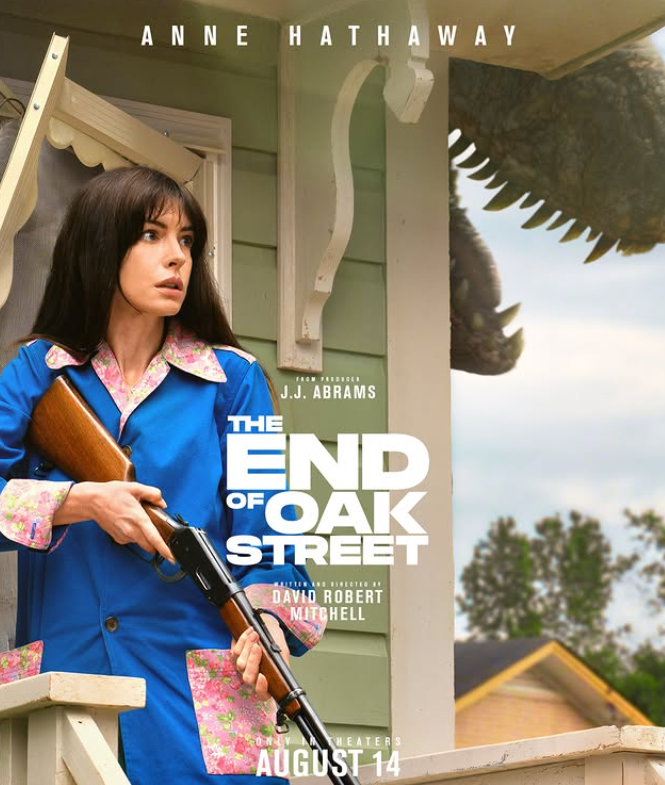
The End of Oak Street review: Anne Hathaway leads an entertaining prehistoric survival adventure that delivers family-friendly thrills, an intriguing time-travel premise and a satisfying climax, even if it falls short of Jurassic Park.
There is a particular challenge that comes with making a modern survival thriller involving prehistoric creatures. The moment dinosaurs enter the picture, audiences inevitably think of Steven Spielberg’s Jurassic Park — a film that didn’t merely popularise the creature-feature genre but fundamentally redefined what cinematic spectacle, suspense and terror could look like. The End of Oak Street, starring Anne Hathaway, walks into that intimidating territory with an ambitious premise involving time travel, prehistoric predators and a family fighting for survival. It never reaches the breathtaking heights of Jurassic Park, but it does manage to deliver something equally important in a different way: a thoroughly entertaining, accessible and family-friendly adventure.
At the heart of The End of Oak Street is a fascinating high-concept idea. A family consisting of Anne Hathaway’s character, her husband and their children suddenly finds itself caught in a terrifying encounter with prehistoric creatures. The film cleverly plays with the question of exactly what has happened. Have the dinosaurs somehow entered the modern world, or has the family been transported into a prehistoric reality? That mystery becomes one of the film’s principal narrative hooks, keeping the audience invested as the characters attempt to understand their circumstances while simultaneously trying to stay alive.
The film’s greatest strength is its straightforward understanding of what a survival adventure needs to accomplish. Once the family is placed in danger, the narrative rarely allows the tension to completely disappear. There is always another chase, another creature encounter or another obstacle standing between the protagonists and safety. The stakes remain refreshingly uncomplicated: survive, protect the family and somehow find a way home.
The decision to place children at the centre of the story is particularly effective from an entertainment perspective. Their presence immediately raises the emotional stakes because every chase becomes more dangerous when the adults are not merely fighting for their own survival but also trying to protect their children. It also gives the film a classic family-adventure quality reminiscent of the kind of movies that younger audiences can enjoy without the material becoming excessively dark or disturbing.
This is perhaps where The End of Oak Street finds its own identity. It isn’t attempting to be an unrelentingly terrifying creature horror film. Instead, it operates primarily as an adventure spectacle. The dinosaurs are threats, certainly, but the film is more interested in the excitement of escaping them than in turning every encounter into a nightmare.
That approach, however, also exposes one of the film’s biggest weaknesses.
The prehistoric creatures never quite generate the level of terror that they should. Jurassic Park understood that showing a dinosaur wasn’t enough; the film had to make the audience feel its presence. The famous T. rex sequence, for instance, derives much of its power from anticipation, silence and the gradual realisation that something enormous is approaching. The End of Oak Street doesn’t consistently achieve that same psychological tension.
Its creature encounters are entertaining, but they rarely become genuinely frightening. You watch the characters run, hide and fight their way out of danger, but you don’t necessarily feel that primal sense of dread that made Spielberg’s film so unforgettable.
The visual effects are another area where the comparison becomes unavoidable. The creatures are perfectly functional within the film’s action sequences, and there are moments when the scale and spectacle work reasonably well. But the effects don’t always possess the tactile realism or visual refinement expected from a major contemporary creature feature.
Again, this isn’t necessarily fatal to the film. The effects are good enough to sustain the narrative and allow the audience to believe in the world the filmmakers have created. But when your film invites comparison with Jurassic Park, “good enough” inevitably feels like a limitation.
Thankfully, the performances provide the film with a human centre.
Anne Hathaway brings the kind of credibility and emotional authority one expects from an actor of her calibre. She doesn’t play the protagonist as a generic action heroine. Instead, there is a grounded quality to her performance that makes the family’s predicament feel believable. Her character’s primary motivation is not defeating prehistoric monsters but protecting the people she loves.
Her co-star and the young actors also contribute effectively to the family dynamic. The children, in particular, don’t feel like mere narrative devices. Their fear, confusion and determination give the survival sequences an additional emotional dimension. Because the audience believes that these characters genuinely care about one another, the danger carries more weight.
The film also benefits from maintaining a relatively brisk pace. It understands that a survival adventure cannot afford to become too self-indulgent. The story keeps moving, mysteries are gradually revealed and the characters are continually pushed into new situations.
And then comes the climax.
Without giving away the specifics, the final act is one of the film’s more satisfying elements. The time-travel component of the narrative eventually pays off in an intriguing manner, and the resolution gives the audience enough to think about without becoming needlessly complicated. The climax demonstrates that beneath the creature spectacle is an attempt to construct a larger narrative puzzle.
That is ultimately what makes The End of Oak Street more enjoyable than its shortcomings might suggest.
It isn’t Jurassic Park. It doesn’t possess Spielberg’s mastery of suspense, the groundbreaking visual effects, the unforgettable sense of discovery or the sheer cinematic terror that made that film a landmark.
But perhaps it doesn’t need to be.
The film works best when viewed on its own terms: as an accessible, family-oriented survival adventure with dinosaurs, time travel, a likeable ensemble and enough mystery to keep the story moving. It delivers thrills without becoming excessively grim and spectacle without losing sight of its characters.
For parents looking for something they can watch with their children, that accessibility could prove to be one of its biggest strengths.
There is also something reassuringly old-fashioned about the film’s approach. It isn’t trying desperately to overwhelm the audience with mythology or franchise-building. At its heart, it is simply a family trying to survive an extraordinary situation.
And sometimes, that is enough.
The End of Oak Street may not reinvent the prehistoric creature genre, and it certainly doesn’t come close to matching the cinematic legacy of Jurassic Park. But it doesn’t need to. It is an enjoyable, reasonably well-crafted adventure that understands its audience and delivers exactly what a family-friendly theatrical experience should: suspense, spectacle, emotion and fun.
The film’s limitations prevent it from becoming truly memorable, particularly when it comes to creature realism and genuine terror. But its strong ensemble, intriguing premise, brisk storytelling and satisfying climax make it an entertaining watch.
Rating: ⭐⭐⭐½ out of 5
The End of Oak Street may live in the shadow of Jurassic Park, but it still manages to find enough light of its own to make for an enjoyable prehistoric adventure.