Physical Address
304 North Cardinal St.
Dorchester Center, MA 02124
Physical Address
304 North Cardinal St.
Dorchester Center, MA 02124

Bollywood news, reviews, interviews & fashion
Bollywood news, reviews, interviews & fashion
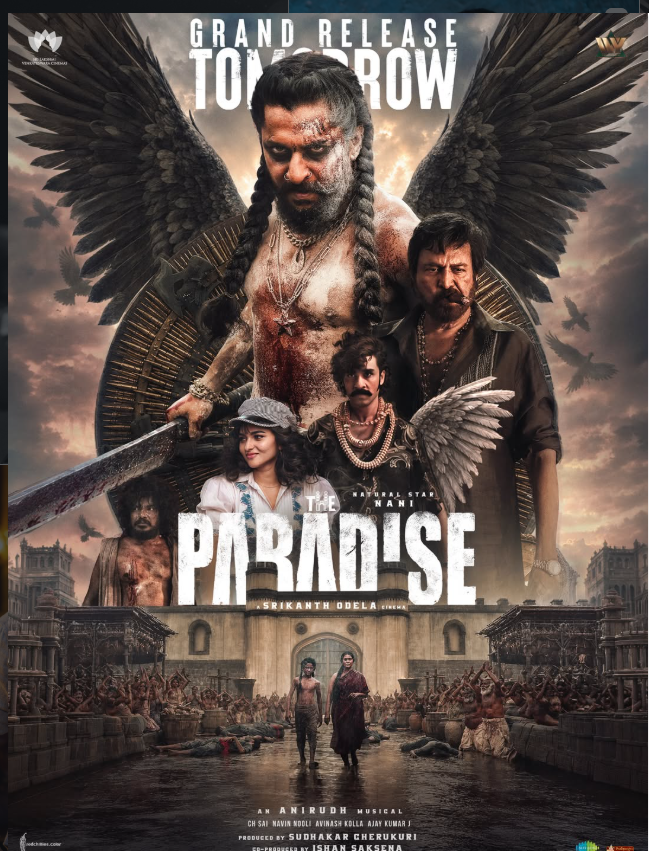
Srikanth Odela's The Paradise is an unbearable, violence-soaked film with almost no plot. Nani gives it his all but can't save it, and Raghav Juyal is wasted. A waste of time and money.
Every star seems to get one. A film arrives that is meant to be a grand statement, a reinvention, a mass-hero apotheosis, and turns out to be an overlong, overindulgent, blood-soaked misfire. Yash had Toxic. Nani now has The Paradise. It is an unbearable film, and I say that with real regret, because the pieces looked so promising.
The setup had pedigree. Srikanth Odela reunites with Nani after Dasara, the debut that won him best director honours at Filmfare, SIIMA and IIFA. The film is set against the backdrop of 1980s Secunderabad and follows a marginalized tribe stripped of their rights who find hope in an unlikely leader. Nani plays Jadal, and he had called the project “India’s ‘Mad Max'” in the run-up to release. Anirudh Ravichander scored it, and Raghav Juyal, the menacing breakout of Kill, was brought in as the villain. Nani, Odela and Juyal together, in a film with that much ambition, should have been an event. What we get is a three-hour endurance test.
The central problem is that there is no plot to speak of. The film has a premise, an oppressed community and a rebellion, but a premise is not a story. The film leans on a familiar oppression-and-rebellion narrative with underwritten characters and an uneven second half. I would go further. Scene after scene arrives without cause or consequence, characters appear and vanish without leaving a mark, and you search in vain for anything to hold on to. Another critic noted that Odela tried to come up with multiple blocks without a proper structure. That is exactly right. It is a series of set pieces, strung together by the assumption that noise equals narrative. By the interval you have stopped asking where it’s going, because it is plainly going nowhere.
Into this vacuum rushes the violence, and it is excessive to the point of numbness. The action is relentless, bloody and protracted, and it never earns its place. Violence in cinema can be purposeful, even poetic, when it reveals character or raises stakes. Here it is simply the film’s only language. Fight follows fight, and each is longer and more brutal than the last, until the brutality stops shocking and starts exhausting. Even the climax, which should have been a face-off between Nani and Mohan Babu, becomes a routine showdown involving cops. Nobody comes out of it feeling anything except tired.
And Nani, an actor I admire deeply, cannot save it. He commits fully, with a striking physical transformation and real sincerity. Even sympathetic reviewers concede that his performance is the film’s biggest strength. But a great performance cannot redeem a film that gives it nothing to do. Nani has built a career on warmth, relatability and an uncommon ease on screen. In the “mass avatar” demanded of him here, he feels like a talented actor in the wrong uniform. This is his Toxic in the truest sense, a star pushed into excess by a film that mistakes volume for greatness.
Raghav Juyal fares worse. Cast on the strength of the chilling intensity he showed in Kill, he is reduced to mannerisms and body language that do not land, in a character the writing never develops. As one review put it, he was wasted in a poorly written character, and none of his attempts to leave a mark worked. His Vikram Malik should have been the menacing counterweight to Nani’s Jadal. Instead he is bad, and the fault is partly his own and partly the script’s, but the result is the same: a talented actor squandered. Mohan Babu and Sampoornesh Babu are similarly lost, and Kayadu Lohar and Sonali Kulkarni have little more to do.
Credit where it is due. Anirudh’s songs are chartbusters, and the production design and cinematography give the film a scale few Telugu films attempt. But spectacle without substance is just expensive noise.
The Paradise is a film with a huge canvas and nothing painted on it. It is violent, bloated and aimless, a waste of Nani’s talent, Juyal’s menace and, frankly, the audience’s time and money. Skip it, and hope that both Nani and Odela return soon with something worthy of them.