Physical Address
304 North Cardinal St.
Dorchester Center, MA 02124
Physical Address
304 North Cardinal St.
Dorchester Center, MA 02124

Bollywood news, reviews, interviews & fashion
Bollywood news, reviews, interviews & fashion
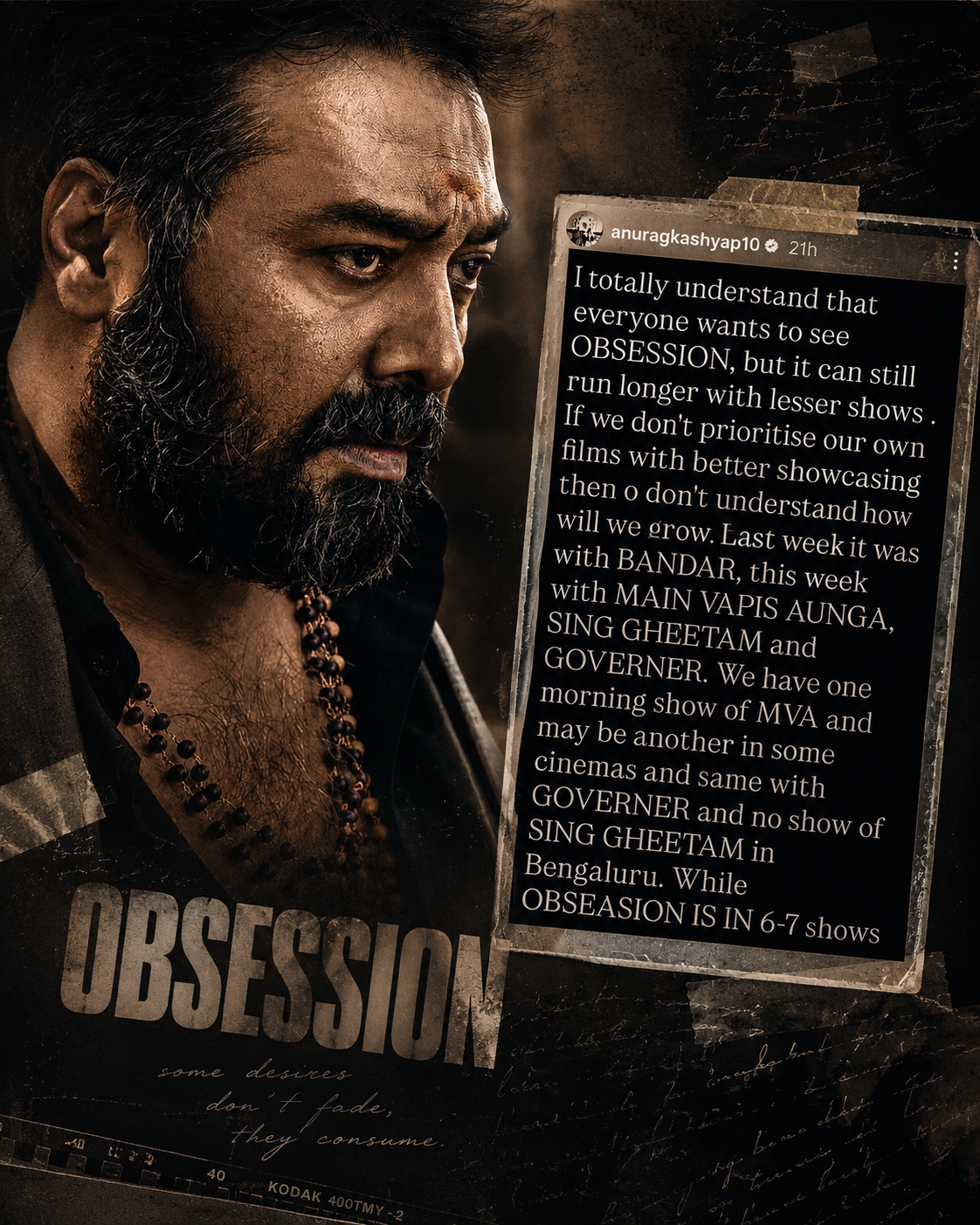
Anurag Kashyap is wrong about Obsession. The film didn't steal screens — it earned them. Here's why the Indian audience's choice deserves respect, not resentment.
Obsession is not stealing screens. It is earning them.
Anurag Kashyap is one of the most important filmmakers India has ever produced. Gangs of Wasseypur is a masterpiece. His voice in Indian cinema is irreplaceable. His anger at the system — at producers, at distributors, at the cowardice of mainstream Bollywood — has often been righteous, and necessary.
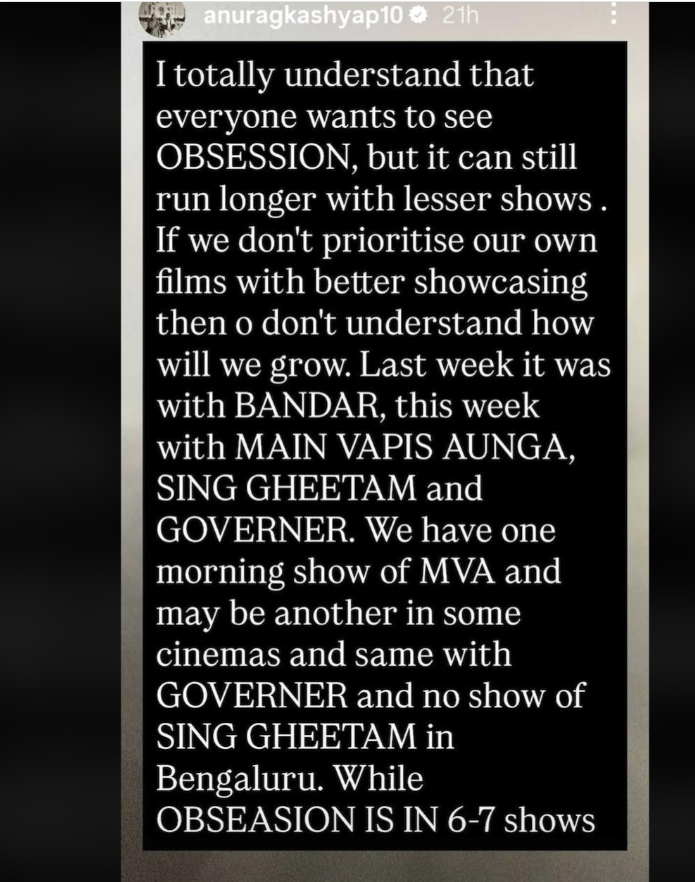
But his latest Instagram story complaining that a foreign film called Obsession is getting 6-7 shows while Main Vaapas Aaunga, Sing Gheetam, and Governer are being squeezed to one morning show or no shows at all — that complaint, however well-intentioned, is deeply, fundamentally wrong.
And it needs to be said.
Before Anurag Kashyap — or anyone — frames this as a case of Hollywood muscle flexing its clout and bullying Indian films off screens, let us be absolutely clear about what Obsession is.
It is not a Marvel film. It is not a franchise behemoth backed by a $200 million marketing budget. It is not Avatar. It is not the kind of Hollywood film that arrives in India with a pre-sold brand, a global media blitz, and an army of corporate relationships to guarantee screens.
Obsession is a psychological horror film directed by Curry Barker — a YouTube sketch comedian making only his second feature film. It was shot in Los Angeles in October 2024 on a budget of $750,000. Three quarters of a million dollars. That is, for context, less than the catering budget on some Bollywood productions. Barker got his break when he uploaded a short horror film called The Chair to his YouTube channel in 2023, which led to an offer from a producer to develop a feature. He is, in every meaningful sense, an independent outsider filmmaker — the kind of person Anurag Kashyap has spent his entire career championing.
The film premiered at the 2025 Toronto International Film Festival and went on to receive a 97% score on Rotten Tomatoes. Critics loved it. And then something happened that no algorithm, no studio relationship, and no distributor’s arm-twisting could manufacture:
The audience found it.
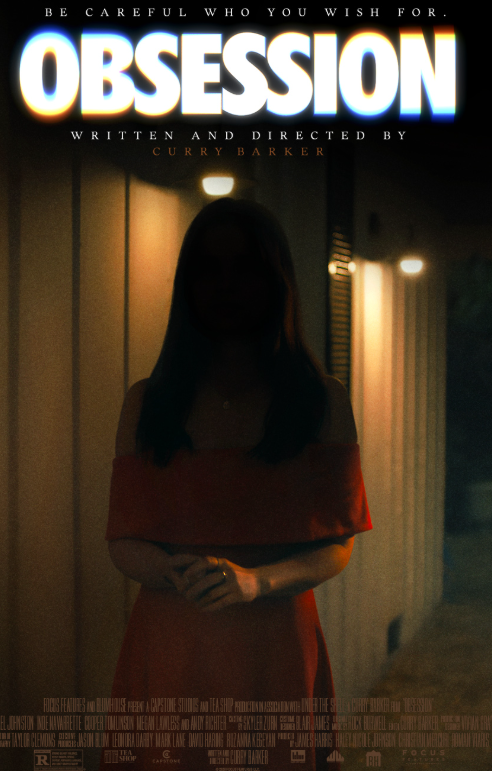
Here is what happened when Obsession released in India on May 29, 2026.
It opened to a mere ₹1.75 crore on its first day. No marketing blitz. No big stars. No franchise name. Just a film.
And then word of mouth took over. Clips from the film began circulating on Instagram Reels. Theories about the characters spread across Reddit. Memes took over Twitter. People who saw it told people who hadn’t. And those people went. And they told more people.
By its second Sunday, the film recorded its biggest single-day haul of ₹7.50 crore — meaning its single day collection almost equalled its entire opening weekend total of ₹7.75 crore. When does that happen? When audiences decide, entirely on their own, that a film is worth watching.
In 16 days, Obsession collected ₹58.85 crore in India alone. Worldwide, the film has crossed $248 million — closing in on $300 million — against a production budget of under $1 million. The total investment including acquisition and marketing was roughly $35 million, meaning the film has returned approximately $4 for every $1 spent.
This is not a film that is on 6-7 shows because a Hollywood studio made some calls. This is a film that is on 6-7 shows because every time it plays, the seats fill up. That is the only reason that matters to a theatre owner. That is the only reason that should matter.
This is the part of the argument that tends to make certain filmmakers uncomfortable, but it is the truth: a multiplex owner’s job is not to protect Indian cinema. It is not to curate culture. It is not to give every well-meaning film a fair shot out of some sense of national duty.
A multiplex owner’s job is to fill seats.
When Obsession fills 6-7 shows a day and Sing Gheetam fills one morning show — or none — the theatre owner is not making an ideological statement against Indian independent cinema. They are making an arithmetic decision. Empty seats cost money. Full seats make money. It is not more complicated than that.
Should we expect a businessman to subsidise an industry’s underperformance? Should a theatre owner in Bengaluru run shows of a film that audiences are not turning up for, purely out of patriotism? That is an extraordinary demand — one that we would never make of any other business in any other industry.
If a restaurant serves a dish that customers are not ordering, we don’t blame the restaurant for eventually taking it off the menu.
Here is the argument that Anurag Kashyap and others in this conversation are conspicuously avoiding: the Indian audience chose Obsession. Nobody forced them. Nobody tricked them. The film saw virtually no week-on-week drop going into its third week — a near-unprecedented feat for any wide-release film. That is not studio manipulation. That is genuine, sustained audience enthusiasm.
Indian audiences are not children who need to be protected from their own choices. They are not being misled by some foreign propaganda machine into watching a film they don’t actually want to see. They watched Obsession because people they trusted told them it was worth watching. They went back for second viewings. They brought friends. They posted about it.
This is the dream. This is exactly what every filmmaker — including Anurag Kashyap — says they want. A film that travels purely on word of mouth. A film that the industry didn’t believe in but the audience did. A film made outside the system that overthrew the system’s predictions.
The only wrinkle, apparently, is that the filmmaker is American.
Let us be honest about what is really being said when a filmmaker complains about Obsession‘s screen count. Underneath the righteous language about “prioritising our own films,” the real complaint is this: our films are not doing as well as that film, and we don’t like it.
That is understandable. It is human. But it is not an argument.
Main Vaapas Aaunga, Sing Gheetam, and Governer are not being short-changed by the market because Obsession exists. They are getting limited shows because — and this is the uncomfortable truth — audiences are not choosing them with the same enthusiasm. That is a conversation the Indian film industry needs to have with itself. About content. About marketing. About whether films are connecting with audiences or simply assuming audiences owe them their time and money.
Obsession arrived with no stars that Indian audiences recognised, no franchise history, no aggressive promotion in this market. It grew from ₹1.75 crore on opening day to one of the biggest Hollywood runs India has seen in recent memory, entirely through organic word of mouth. If an Indian film did the same thing, Anurag Kashyap would be the first person celebrating it as proof that good cinema always finds its audience.
The principle cannot change because the passport on the film’s cover does.
None of this is to dismiss the very real, very serious problem of Indian independent and mid-budget films struggling for screens. That problem is genuine. The system is stacked against films that don’t arrive with a big star or a franchise name. Small films — Indian or otherwise — often get crushed in the opening weekend machine before audiences even have a chance to discover them.
But the solution to that problem is not to restrict a competing film that audiences love. The solution is to ask harder questions.
Why are Indian studios not developing the kind of word-of-mouth horror films that can travel globally? Why are multiplex chains not building dedicated screens for indie content, the way art-house cinemas function in Europe? Why is the OTT pipeline so accelerated that a film gets pulled from theatres before audiences can organically discover it? These are structural problems that require structural solutions.
Blaming Obsession for being too good at its job is not a structural solution. It is a deflection.
Curry Barker made a film for $750,000 in a Los Angeles music store, about a boy who makes a wish and gets more than he bargained for. No stars. No budget. No connections. He screened it at TIFF. A distributor believed in it. Audiences found it. And now it is playing to packed houses in Mumbai, Delhi, Bengaluru, and Hyderabad — because the people in those cities walked in, watched it, loved it, and told everyone they knew.
That is not a scandal. That is cinema doing exactly what cinema is supposed to do.
The Indian film industry — including its most talented, most passionate voices — would do well to study what Obsession did right, rather than complain about the screens it earned.
The audience is always right. Even when they’re watching a film we wish they weren’t.